
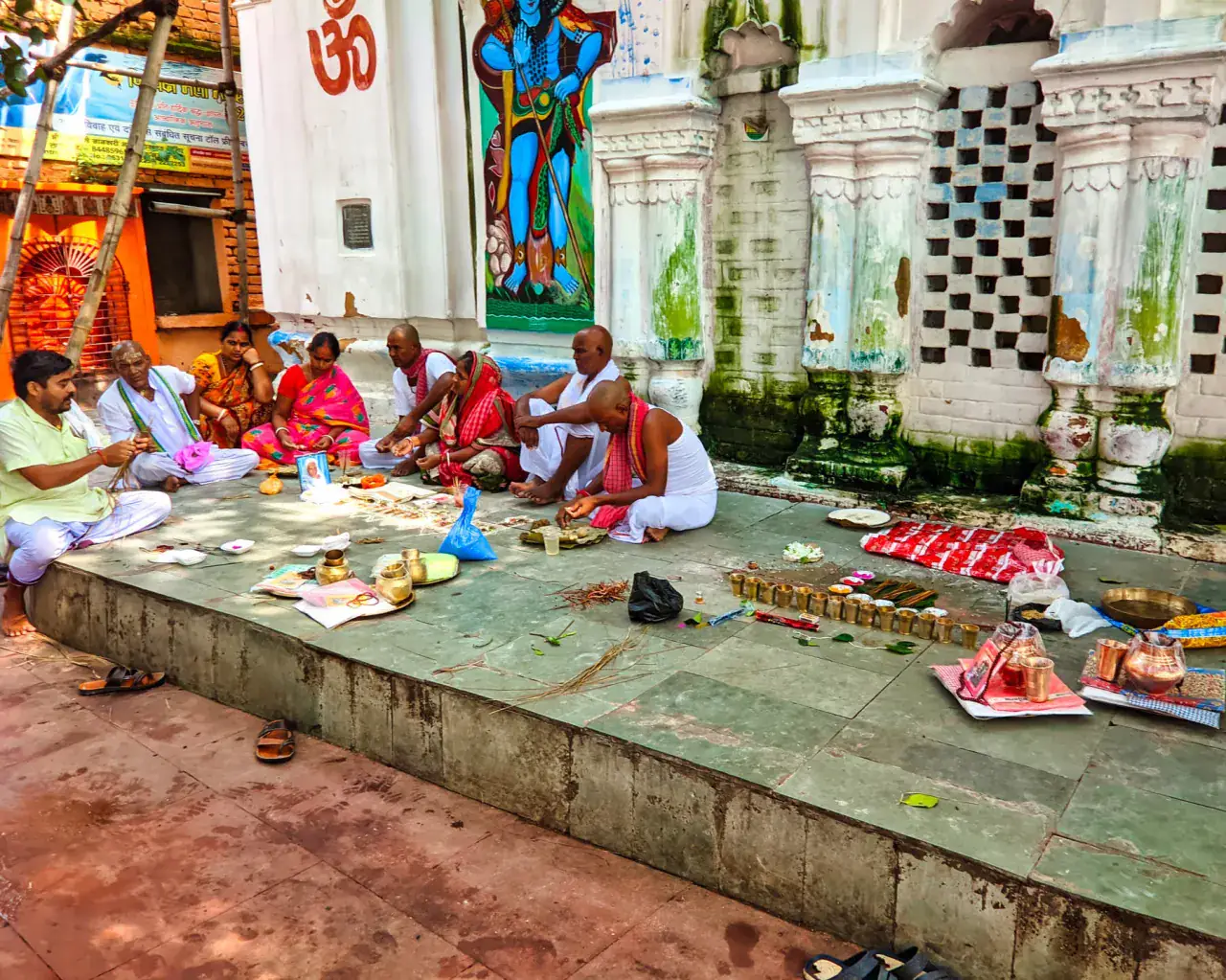
Families often arrive at this question with a sincere worry: if the customary performer cannot travel, may another family member undertake Pind Daan at Gaya? The answer should not be reduced to a single internet rule.
A son is the customary first choice in many families, but the absence of a son does not by itself provide a complete answer. The relationship to the departed, family tradition, rites already performed and the guidance followed at Gaya all matter. The respectful course is to understand the usual possibilities, then let the appropriate officiating pandit confirm the performer and sankalpa for your family.
Why the question matters at Gaya
The Vayu Purana's Gaya Mahatmya honours Gaya as a foremost Pitru Kshetra, a sacred field associated with ancestral observances. Vishnupad, the Phalgu and Akshaywat give the ritual morning its distinctive geography, while the sankalpa connects the place, the departed and the person making the offering.
For this reason, “who will perform?” is not merely a travel detail. It affects the names recited, the relationship stated in the sankalpa, the observances followed and the way the pandit guides the family. Settling it calmly before travel allows the rite to begin with clarity rather than uncertainty.
The three things that decide who should lead
Family tradition
Different regions, communities and family lineages may follow different orders of preference. If your family has a trusted purohit or established custom, record that guidance first.
Relationship to the departed
A close descendant is commonly preferred, but the relevant relationship may be a son, daughter, grandson, spouse, adopted child or another relative depending on the family's circumstances.
The officiating pandit's guidance
At Gaya, the Gayawal pandit who will conduct the rite must know the relationship, purpose and any unusual circumstance. This is especially important when there is no direct descendant, more than one possible performer or differing views within the family.
Common family situations
A son is able to perform
This remains the widely recognised customary situation. When several sons are present, the family and pandit decide who leads and how the others participate; an eldest-versus-youngest rule should not be assumed without checking the tradition followed.
A grandson or another close descendant is available
This may be considered when a son has predeceased the parent, cannot travel or is otherwise unable to perform. The precise line of relationship should be shared with the pandit.
A daughter wishes to perform
Many families bring this question to Gaya. It should not be answered with either an automatic prohibition or a universal promise. The family tradition, absence or availability of other performers and the officiating pandit's guidance should be considered together.
A wife or husband wishes to perform for a spouse
Spousal performance is addressed within particular traditions and circumstances. Share the relationship and rites already completed so the pandit can confirm the appropriate form.
An adopted child wishes to perform
Adoption should be described openly rather than treated as an awkward detail. The pandit can then apply the family's lineage and customary understanding correctly in the sankalpa.
Several relatives wish to take part
A family may attend together even when one person leads the principal offering. Ask how names, participation and supporting observances will be arranged rather than assuming that everyone must perform separately.
Women performing Pind Daan at Gaya
This deserves a careful answer because families often hear opposite claims. Some traditions and pandits permit a daughter, widow or another eligible woman to lead in defined circumstances; other families follow a different customary order. Neither practice should be turned into a rule for every family.
If a woman in the family wishes to perform, share who the rite is for, whether another close descendant is available, the family custom and any guidance already received from the family purohit. If relatives hold different views, it is kinder to discuss them before travel. The purpose is not to win an argument at the tirtha, but to approach the ancestral duty with shared understanding.
When there is no direct descendant
A nephew, more distant relative, disciple or another person connected to the departed may sometimes be considered, but this is not a case for a general promise. The officiating pandit needs the complete relationship and the reason no closer performer is available before advising on the sankalpa.
Send this question early in the planning process. The yatra can remain customisable, but the ritual decision should be settled before travel dates, fasting expectations and the Gaya morning are finalised.
Information the pandit will need
The person or ancestors being remembered
Names, relationship to the proposed performer and, where known, the family line.
Who wishes to perform
Include every possible performer and explain adoption, remarriage, estrangement or another lineage question plainly.
Gotra and family tradition
Share the gotra if known and say honestly if it is uncertain. An unknown gotra does not end the conversation; the pandit guides the appropriate sankalpa wording.
Date or tithi
Provide the civil date of death and observed tithi if the family knows them. If either is uncertain, say so rather than estimating.
Rites already completed
Mention Shraddham, Pind Daan, asthi visarjan or another observance already undertaken, including where and by whom.
Health and practical needs
Fasting, early starts, heat, wet or uneven surfaces and sitting during the rite may affect the performer. These needs can be considered while shaping the itinerary.
Questions that do not need to stop the enquiry
The ashes are not with the family
Pind Daan and asthi visarjan are different observances. Tell the coordinator if ashes are being carried, but their absence does not by itself answer who may perform Pind Daan.
The gotra is unknown
Begin with family elders, documents and a family purohit if available. If it remains unknown, let the officiating pandit guide the sankalpa rather than inventing an answer.
Many years have passed
The passage of time does not make the question unworthy. Share when the death occurred and what observances were performed so the pandit can advise the suitable occasion and form.
The family is unsure about head shaving
Mundan customs vary. Discuss it as a separate observance with the pandit; it is not, by itself, a test of who may perform the rite.
More than one ancestor is to be remembered
The names and relationships should be shared in advance. The pandit will explain how they can be included within the family's sankalpa and ritual sequence.
What should be clear before the journey
Before the itinerary is finalised, ask for a clear written understanding of who will lead, which ancestors will be named, what family information is still needed, any fasting or clothing guidance, the likely ritual setting and support required by elders or anyone with limited mobility.
The most reliable answer is a calm, family-specific confirmation made with the appropriate pandit before the sacred morning begins.