
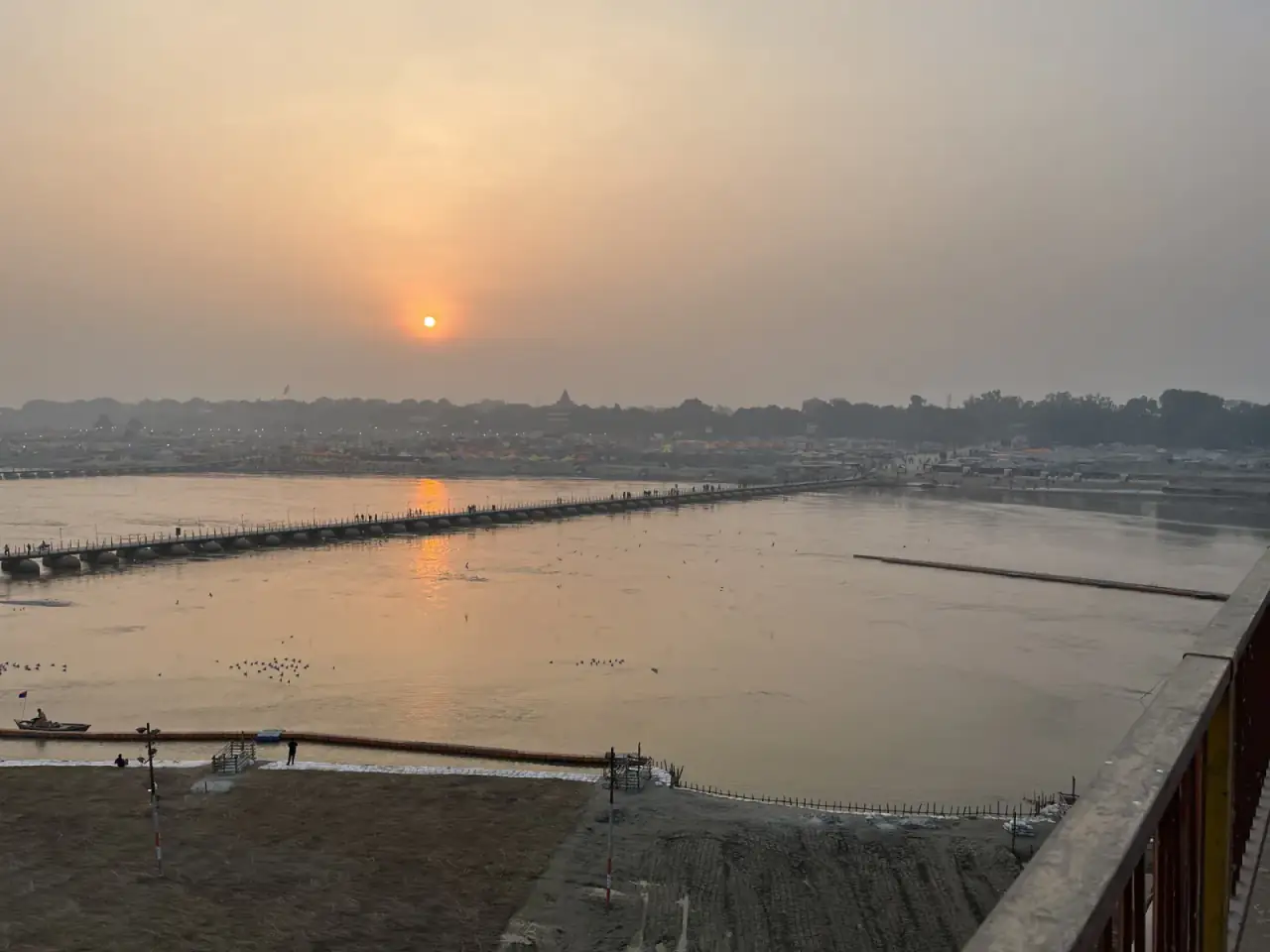
Prayaga is the ancient name by which the sacred confluence at present-day Prayagraj has been honoured for generations. Here the Ganga and Yamuna meet in sight, while Saraswati is revered as joining them unseen. The meeting is called Triveni Sangam —the confluence of three sacred streams.
For a first-time pilgrim, the Sangam may appear gentle rather than grand: open water, boats, broad riverbanks and the meeting of two visible currents. Its greatness is understood through sacred memory. The Puranic tradition calls Prayaga Tirtharaja , the foremost among tirthas, and families approach it as a place of purification, prayer, remembrance and renewal.
What Tirtharaja means
A tirtha is a sacred crossing—a place where the pilgrim turns from ordinary movement towards worship. Tirtharaja means the king or foremost of such sacred places. The title expresses Prayaga's honoured position in the pilgrimage tradition; it is not a comparison a family must use to diminish the greatness of Kashi, Gaya, Rameshwaram or another tirtha.
The Matsya Purana's Prayaga Mahatmya praises the confluence and speaks of the sanctity of bathing, giving and worshipping here. The Mahabharata's Tirtha Yatra tradition also remembers Prayaga as an important place of pilgrimage. Together, these traditions help explain why the Sangam has remained a destination for householders, renunciants and whole families across many centuries.
At the practical level, this means a Sangam visit is approached with intention. The family knows why it has come, makes the sankalpa advised for it and allows enough time for the rite or prayer rather than treating the water as a brief sightseeing stop.
The meaning of Triveni Sangam
The Ganga is revered for purification and grace. The Yamuna carries her own ancient sanctity and is deeply connected with Krishna traditions. Saraswati is honoured at Prayaga as antahsalila, flowing unseen. Their meeting is called Triveni: three streams joined like the strands of a braid.
Pilgrims do not need to turn this sacred understanding into a debate about what can be photographed. The tradition invites a simpler disposition: two rivers are visible, the third is received through faith, and all three are remembered in the prayer at the confluence.
Depending on current river conditions and local arrangements, the Sangam point may be approached by boat or from an authorised bank or bathing area. The exact point, boarding arrangement and safe manner of receiving the water should be confirmed locally.
What families may undertake at Prayaga
No single list applies to every traveller. The purpose of the yatra, the family tradition, health and current access all matter. A Prayaga visit may include some of the following:
Someone who cannot enter the water deeply should not feel excluded. A respectful form of participation can be discussed with the pandit, while river-safety directions and local permissions are followed at all times.
Sankalpa
the prayerful statement of who is undertaking the observance and for what purpose.
Sangam snan
a sacred bath or respectful receiving of the confluence water, undertaken only in the manner safe and suitable for the family.
Tarpana or ancestral observance
offerings of water or other rites when these form part of the family's sankalpa and are guided by the appropriate pandit.
Dana and prayer
giving and worship have a respected place in the Prayaga tradition, particularly when undertaken quietly and without display.
Setu offering, if applicable
some Kashi–Rameshwaram traditions bring ritually prepared sand from Rameshwaram for offering at the Sangam. This is confirmed, not assumed, for each family.
Receiving sacred water
in the returning Setu–Ganga circuit, water may be carried south for the concluding worship at Ramanathaswamy. The container, quantity and travel handling should be planned beforehand.
Magha and the living pilgrimage season
The lunar month of Magha holds special importance at Prayaga. The tradition of kalpavasa—a disciplined period of prayer, bathing, restraint and dwelling near the confluence—is associated with this season, and the annual Magh Mela continues to bring large numbers of pilgrims to the Sangam.
Magha is meaningful, but it is not the only time a family may approach Prayaga. Panchang dates change from year to year, and large gatherings alter roads, walking distances, boat access, accommodation and waiting times. Some families consciously choose the Mela atmosphere; others require a calmer period because of age, health or the nature of their rite.
The right choice is the one made with full understanding. Confirm the lunar dates with the appropriate pandit and the practical conditions with the current itinerary before booking travel.
Veni Madhava and Prayaga's sacred geography
Prayaga is also connected with a revered Madhava tradition. Madhava is a name of Vishnu, and Veni Madhava is remembered in relation to the sacred braid of the confluence. Pilgrims may also hear of Prayaga's Dwadasha Madhavas—the twelve forms of Madhava associated with the wider sacred landscape.
Shrine identity and present-day visiting routes can be explained differently by local traditions. If Veni Madhava darshan belongs to the family's observance, the correct shrine, route and timing should therefore be confirmed locally rather than inferred from a general online list.
The name also helps a pilgrim understand the confluence as more than a point on a map. Prayaga includes waters, deities, banks, temples, akharas and long-established ritual communities. A thoughtful visit leaves room for this wider sacred geography when the family's time and purpose allow.
Prayaga in the Kashi–Rameshwaram yatra
In the Setu–Ganga form of the Kashi–Rameshwaram yatra, Prayaga can become the meeting point between the journey north and the return south. A designated Setu offering may be brought from Rameshwaram to the confluence, and sacred water may be received for the concluding worship at Ramanathaswamy.
This gives the route a beautiful sense of relationship: the southern sea is remembered at the northern confluence, and the grace of the northern waters returns to the southern shrine. Families do not all follow one identical form. Your prayerful purpose (sankalpa), family tradition (sampradaya) and any rites already completed help the pandit decide what is appropriate.
Kashi, Prayaga, Gaya and Rameshwaram also retain their own sacred importance. The complete circuit brings them into one pilgrimage without reducing any place to a transit stop.
How to arrive prepared
Before the Sangam morning, confirm the meeting point, transport, boat or bank arrangement, expected walking, current weather and river conditions, clothing, changing needs and the exact observances included. Children, elders and anyone with limited mobility should be considered in the route from the beginning.
If a boat is used, follow the operator and local authority's safety instructions, use the provided safety equipment and avoid standing or leaning for a photograph. Deep immersion is never a measure of devotion. The water can be received in a safer form when advised, and the family's pandit can guide the prayer without placing a vulnerable traveller under pressure.
Prayaga asks for neither scepticism nor spectacle. It asks the pilgrim to arrive with shraddha—reverent trust—understand the sankalpa and approach the confluence with humility. Once that foundation is clear, even a simple prayer upon the water can hold the meaning for which the family has travelled so far.